
Threatening Oman highlights how Trump has killed off US diplomacy ... but what's really new?

The region is overdue for a new security arrangement that takes into account the lives and aspirations its people.
Trump has threatened to “bomb the s**” out of Oman for the second time this year. A shocking repeat threat against a country that has served as a friend and mediator for the US for years.
What’s new about US power in the Middle East under Trump is not its destructive capacity, its blatant disregard for the lives of ordinary people, or its desire to keep oil and petrodollars flowing its way. No, all of this is simply how America operates. Trump is no aberration.
What is new is the absence of any diplomatic speak that paints over its violence and gags its belligerent confidence. Trump’s particularly fickle form of verbal vomit sees him adulate dictators in the same week he threatens his partners. The volatility of American discourse under his leadership compounds the anxiety and instability resulting from his behaviour.
Threats and more threats
Fox News reporter Trey Yingst said he had asked the president about parallel talks taking place between Iran and Oman about the control of the Strait of Hormuz, to which Trump replied: “If Oman gets in the way, we’ll bomb the s*** out of them.” In May, also speaking about opening the Strait, Trump made a similar threat: “Oman will behave like everybody else, or we’ll have to blow them up.”
The day after the latest threat, the White House shared Donald Trump’s Truth Social post on their official X account, with an image identifying the Strait of Hormuz as “New U.S. Territory,” echoing the president’s comment that “pretty soon I’ll be declaring the Hormuz Strait a territory of the United States.”
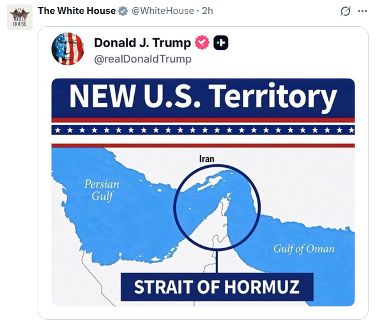
Encompassed within the identifying circle in the image of the Strait are not only Iranian territory but also Omani and Emirati territory. Crossing this key waterway requires ships to pass through the territorial waters of Iran and Oman, making Iran’s ability to close it and threaten international shipment a key thorn in the side of the president’s flesh.
Trump’s threats sound alarming in the world of diplomacy, even if no one expects him to actually bomb the Sultanate.
Why target a longstanding ally?
Today, Oman is appreciated as a country that has carefully cultivated its neutrality, allowing it to serve as a trusted mediator. It is credited with playing a key role behind the Joint Comprehensive Plan of Action (JCPOA), and Muscat has served as a vital backchannel between Washington and Tehran for years.
The Gulf country has also played an important role in the release of various American hostages in Iran and Yemen over the years.
This relationship emerges from a long history of friendship between the countries, with ties sitting among the longest of any Arab nation. These extend from the 1833 treaty of friendship and commerce between the two nations to the signing of the US-Oman Free Trade Agreement in 2006 (in effect since 2009) – one of the US’s only 20 bilateral FTAs worldwide.
This rich diplomatic history includes Oman being credited with dispatching the first Arab emissary to the United States in 1840 when Ahmad bin Na‘aman, special envoy of Sayyid Sa‘id bin Sultan (the Sultan of Oman and Zanzibar), visited New York. Not only this, but the first Arab head of state to make an official visit to Washington was Omani Sultan Sa‘id bin Taimur who met with US President Franklin Roosevelt in 1938.
Within this context, Trump’s threats to Oman appear puzzling. Both instances emerge as reactions to Oman’s role negotiating with Iran over access and navigation through the Strait. It’s not only Oman’s record of diplomacy and its proven status as a mediator with Iran, but also the geographic position that makes it both logical and necessary for the Gulf country to be involved.
Even more peculiarly, the June 17th 14-point Islamabad Memorandum of Understanding Between the United States of America and the Islamic Republic of Iran specified in point 5 that: “Iran will conduct dialogue with the Sultanate of Oman to define the future administration and maritime services in the Strait of Hormuz”. Observers had hoped the current dialogue would be a precursor to a renewal as the 60-day MOU was about to expire.
The agreement had already frayed by the beginning of July as Iran launched strikes on a number of ships and the US renewed its strikes on Iran for nearly two weeks. It was after this that Iran blatantly refused direct talks with the US, accusing it of first violating the terms of the MOU, and began talks with Oman.
Mediators Pakistan and Qatar were reportedly exchanging messages, but Iran has denied any negotiations. In the end, the deal expired.
Undermining peace
Oman’s independent policy toward Iran means it does not always align with US foreign policy, but this characteristic is what enables the country to facilitate dialogue and negotiations. Oman was in fact hosting nuclear talks between the US and Iran just before Trump and Netanyahu launched the war in February. Oman’s foreign minister Badr Al Busaidi tried to pre-empt this by publicly declaring that “a peace deal is within our reach” just the night before bombs started falling.
He later expressed his dismay that “active and serious negotiations [had] yet again been undermined,” referring to the launch of the 12-day war the previous year, which Israel started just two days before the sixth round of US-Iran nuclear talks were set to begin in Oman.
Trump is indeed upending the niceties of American diplomacy and rupturing long-standing relationships. He has recently given a cold shoulder to South Korea as he rekindles his love affair with Kim Jong-Un, has sided with Russia in UN resolutions on Ukraine, and has repeatedly made obnoxious, expansionist threats to make Canada the fifty-first state and seize control of Greenland. In that vein, Trump has already unilaterally renamed the Gulf of Mexico the Gulf of America and violated international law by abducting Venezuelan president Nicolas Maduro.
It’s muzzle off, open bullying.
No force of good
We might consider it a collapse of American diplomacy and its cover of democracy promotion around the world.
But let’s not kid ourselves. People who mourn the US’ role in the world are mourning an illusion. Authors have challenged this virtuous self-delusion for decades, trying to explain to Americans just why people hate America.
Indeed, the US in the Middle East was no force for good. Ask the Palestinians bearing the brunt of American support for Israel’s genocide in Gaza under Biden, Yemeni wedding attendees murdered by Obama’s drones, or the hundreds of thousands of children who died of starvation under Clinton-supported sanctions (infamously deemed “worth it” by then US ambassador to the UN, Madeleine Albright). The list can go on at length and extend well beyond the confines of the Middle East.
The US’ ongoing support for Israel’s genocide in Gaza and its war on Iran are only the latest episodes in what Marc Lynch has dubbed America’s “ruination of a region.”
Trump’s only stable regional pursuit may be expanding the number of Gulf signatories to the Abraham Accords, a desire that Kayhan Valadbaygi calls “low-cost US hegemony,” which positions Israel as its central military-security node.
The Accords are consistent with around four decades of USFP in the region, built on several goals. One includes fostering or forcing Middle East allies into relations with Israel – exemplified by the 1996 Qualifying Industrial Zones initiative, which gives goods produced in Jordan and Egypt duty-free access to US markets on the condition that they include Israeli inputs. The other goal is containing (previously Iraq and) Iran and its proxies. The war has exposed the failure of the latter.
Iran has not been contained, and this policy has had deleterious effects on people, communities, and regional security.
Oman's foreign minister recently wrote that containment is a “myth” and “an error of nearly half a century” and has called for replacing containment with a new security logic to govern the region - one based on inclusion. This will require, in his assessment, “Gulf conversations for Gulf states” to reassess their ties with powerful allies like the US – “not to discard these…but perhaps to reset them” to match the realities revealed during the war. This avoidable war has forced an “essential” question for Oman and its GCC partners: which partnerships genuinely delivery security, and which "bring unwanted vulnerabilities.”
The unsettling difference in current US foreign policy is Trump’s unpredictability. Sandwiched between the US and Iran, Oman remains the only adult in the room – a stable mediator not retaliating in words but sufficiently confident to condemn poor behaviour and violations of international law.
Indeed, the region, middle powers worldwide, and the wider international community would benefit from considering Oman’s words. In fact, the region is overdue for a new security arrangement that takes into account the lives and aspirations of its people.